7 min read
Place Sweet Joe Pye Weed at the Woodland Edge
Use the change from open sun to woodland shade to place a tall perennial with pink flowers late in summer.
On this page
A woodland bed often has a narrow strip where the light changes quickly. Under branches, the ground stays fairly cool and older leaves cover most of the soil. A few feet closer to the path, the sun reaches plants for part of the day. That strip can suit a perennial that needs enough light to flower without being placed in the hottest, driest part of the garden. Sweet Joe Pye weed can bring a high layer of pink flowers into that space. Its height is useful if the flowers are visible over shorter plants, and difficult to manage if the stems grow directly into a walking route.
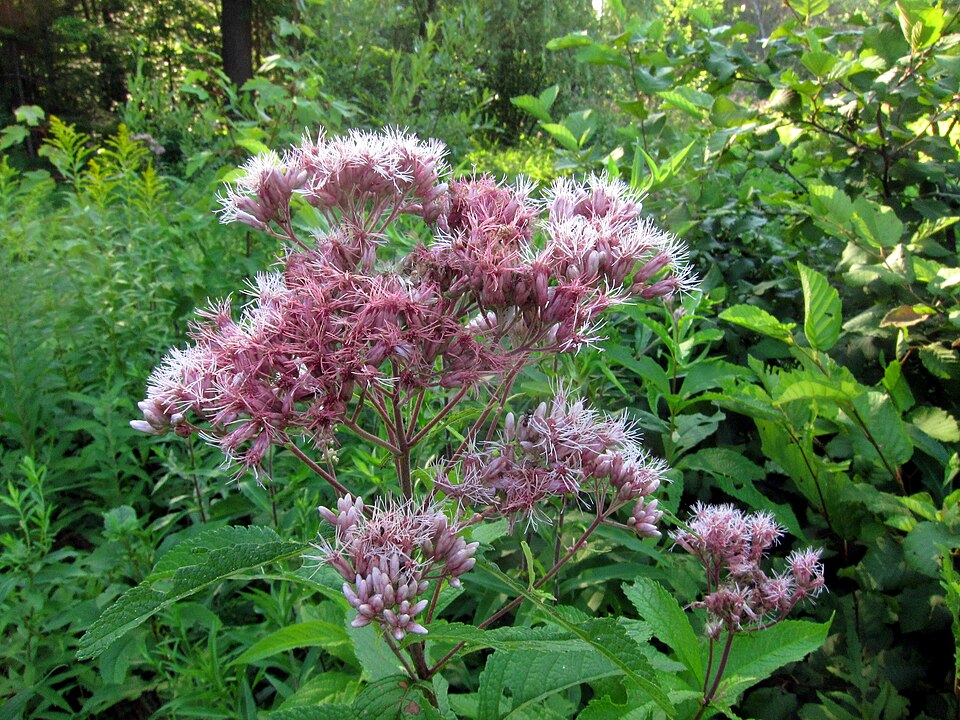
Nurseries use the name Joe Pye weed for several species and a number of garden selections. The one discussed here is sweet Joe Pye weed, Eutrochium purpureum, native to parts of eastern and central North America. Its leaves gather in rings around the stems. Clusters of small pink to purple flowers make domes held above the foliage, usually late in the summer into early fall. Choose a plant with the botanical name on its label and keep the name with the planting notes.
Assess the ground once the trees have leaves
A patch that looks bright in early spring may be dimmer by the time the perennial is ready to flower. Watch the site on two or three days after the overhead canopy has filled in. Note the hours when sunlight touches the ground and how the afternoons feel in the open portion. On a hot site, light shade late in the day can spare some moisture. Dimming most of the sky with a roof or a thick evergreen creates a deeper shade than this perennial generally needs.
Use a narrow trowel to see how dry the soil gets after several days without rain. A damp top can hide a dry layer lower down, and a shaded surface under fallen leaves is not proof of moisture. Tree roots can take up water before new perennials reach it. Your best spot may be outside the thickest network of roots where water reaches the soil and light still filters past a tree. If the ground feels sandy and dry soon after rain, choose a site that holds moisture more reliably or grow a perennial better suited to dry shade.
Check the same area after a strong downpour. Sweet Joe Pye weed grows in a range of soils but favors a root zone with moderate moisture. It can take full sun where the soil stays reliably moist. A ditch under standing water for long periods calls for plants suited to those conditions. In particular, some other species sold under the common name are better adapted to wet sites. Check those separately if you want to plant near a flooded basin or a very wet pond edge.
Avoid cutting into large tree roots to make a new bed. Use an open section beyond them where a spade can enter without force. You can see the eventual boundary from above once the clear patch is marked. Move a potential planting a little sideways if this leaves both roots and access intact. The ideal spot on a sketch is rarely worth damaging a tree to reach.
Plan around the stems that will be there in August
Under favorable conditions, Eutrochium purpureum can reach five to seven feet (about 1.5 to 2.1 meters) in height and two to four feet (about 60 centimeters to 1.2 meters) in width. A young specimen may occupy only a small part of that space. Place a cane at the expected high point and mark the approximate mature footprint at ground level with two pots. Walk past them from each direction. If you keep interrupting a path, move the plant now or buy a shorter verified cultivar suited to the same site.
Look for a backdrop that makes the upper flowers easy to see. The shape of pale domes against a dark hedge or trunks is distinct in the late afternoon. With taller perennials immediately behind them, the outline may blur and the ground around the stems may be inaccessible. A small clearing or a quiet wall of foliage behind them can serve better. Reserve room lower down for a shorter plant that does well in the same light, while leaving a visible gap around the base of the larger clump.
At a path bend, keep taller stems behind the turn rather than above the place where people need to see the route ahead. A stool or chair well outside the mature footprint can provide a spot to watch activity around the flowers. If bees visit, give them space and watch from whichever side leaves the route open. A flower garden near a doorway can work when wings and people have their own routes through it. Move the focal plant away from a narrow gate when neither path can move.
One clump can be enough to establish the scale of the planting. For a longer border, repeat plants with room between them for their mature spread. The individual domes are easier to recognize when they rise from a dark background and do not crowd the canopy above. An awkward blank in the first year can be left open. Once a late plant begins reaching its expected height, the relationship between it and its neighbors is easier to judge.
Establish a small plant through its first dry spell
Choose a planting window when you can watch the soil and avoid the harshest local weather. Water a dry nursery root ball before putting it in the ground. Set the top level with the surrounding soil, fill in and water thoroughly. For the next several weeks, check a little way into the ground instead of assuming that the original watering has settled the matter. Add water when the root zone begins drying, then check again after a rain. Clayey soil and light loam can absorb and retain very different amounts of water.
A thin layer of organic mulch conserves moisture and marks off the young plant. Draw the mulch away from the stem bases so they remain visible. Check for weeds under the mulch and remove them by hand while the roots are shallow. Cultivating close to the plant can disturb the growing crown. Where leaves fall from above, let a loose layer settle beyond the crown but keep bulky, wet mats from pressing over the small stems.
Monitor the first substantial dry spell. A plant in afternoon shade may still need water if nearby tree roots take up moisture. If the clump wilts late in the day, check again the following morning and feel the root zone. Repeated wilting in moist soil calls for a closer look at drainage and roots. Individual damaged stems can be removed cleanly at the base. Avoid increasing watering on a set schedule when the soil is already wet. A quick check with a trowel tells you whether a regular shower has actually reached the roots.
Make space to see the late flowers
As the tall stems extend, take a look from farther back. Their top growth may sit above the lower plants for several weeks before the domes open. This can be part of the appeal if you have left a narrow band of low foliage visible from the front. When the flower color develops, turn your attention to the sky behind it. In some places the clusters stand out best viewed from a side path or seating area. When a sunny opening lies beyond the plants, look with the light to one side rather than straight into it.
The flowers attract bees and butterflies, though which visitors arrive depends on where you live and what else flowers nearby. Look at one cluster over a few days, including a calm spell and a warm bright afternoon. If you want to compare activity from year to year, note roughly when the first clusters open and when the last ones finish. The date varies with weather. A record of relative bloom time helps when deciding which smaller plants will make good neighbors.
After bloom, decide how long you want the stems to stand. In a space where volunteers are acceptable and the species is locally suitable, some spent heads can add winter texture and offer seeds. Clip unwanted heads before they release seeds. Where a bent stem leans into a path, remove that stem lower down while leaving the others. Check for hazards before leaving brittle stems near snow-clearing or a route used daily. Old stems can generally be cut before new growth starts.
The woodland edge will look different when the overhead trees drop their leaves. Use that time to see where the perennial's outline fitted well and whether the short plants had enough room. If you need more width between a crown and path, move a plant in appropriate conditions instead of trimming the same stems every year. Another possibility is to make the path bend wider. Leave the spots you already enjoy alone long enough to see how the planting matures. A few well-placed domes can make the shift from midsummer to autumn visible from the whole garden.
Further reading: NC State Extension profile of sweet Joe Pye weed.